Wednesday, December 19, 2018


Friday, November 09, 2018
Preserving and Promoting Cultural Identity Pt 1
Chikuni Tonga Music Festival
By Matongo Maumbi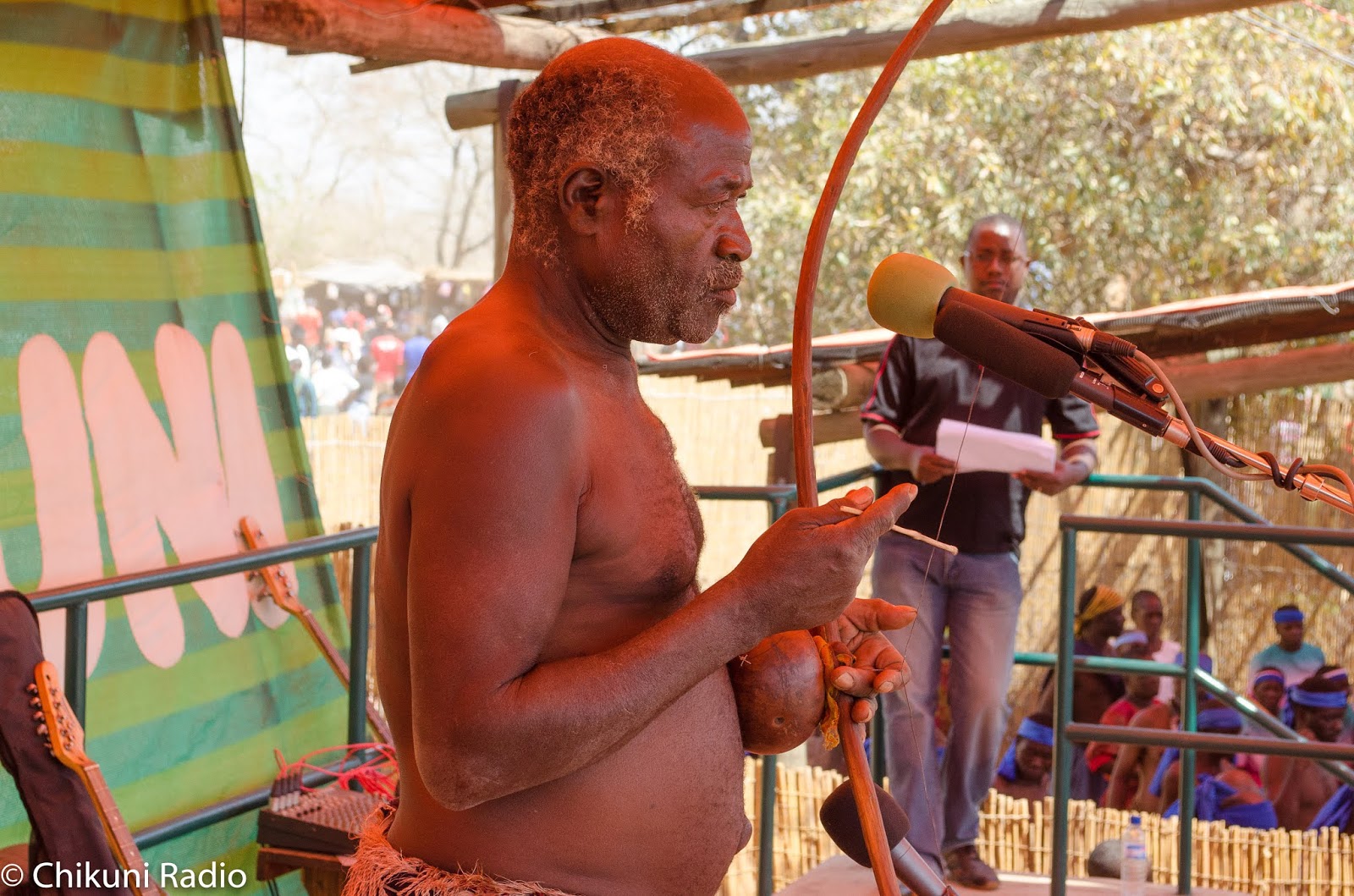 The moment the first home-made string vibrates through the sound system, one cannot manage suppressing a joyous smile from the face, forgetting the tens of kilometres walked to witness a show like no other. Ululations, bleating and cheers fill the air, signifying a true moment of good days in a life of someone who values culture.
 This is the Chikuni Tonga Music Festival, dubbed Nkosaadi in Tonga. Started in the year 2000, it has now become the beacon of traditional music restoration in the Southern regionof Zambia.
The more than 10,000 spectators always have a memorable time of revisiting their culture.

death.
Over the years, the concert has brought renowned Tonga drummers and string pullers
together as brothers and sisters, not adversaries. People go ‘hail’ to the jives of Kalindula (a
local classical lyric), new to the Tonga string system but incorporated in its tunes – for
culture is dynamic.
Renowned Zambian Guitarist, ‘Sir’ Jones Kabanga, a couple of years ago said even though
he had “never attended the Nkosaadi, from the pictures I say it's the only festival that we have that is well organized and the music that is played there is hundred percent Tonga!”
“Yes! We have always used music to educate and remind ourselves where we are coming
from, where we are and where we are going to! The festival to me does that!”
The Tonga Music Festival is critical as “local culture is disappearing at an alarmingly fast rate, humanity is heading towards a mono-culture - and that is a sad place to be! We need cultural diversity on this planet!” laments Michael Baird, Zambian born musician and founder of Sharp Wood Production (SWP) in the Netherlands.
Just like Chikuni Radio, Michael seeks out exponents of various indigenous styles in the
bush. With his educated musical ear, he feels “the Chikuni Tonga Music Festival is a beacon
of light that shows the rest of Zambia - and in surrounding countries - the way. This event
presents local music culture and makes the Tonga and Ila proud of their roots.”
The biggest discovery of the earlier Concerts are groups like Mashombe Blue Jeans, Green
Mamba, Short Mazabuka, Bana Haampongo and many others. These bands went on to
produce more a couple of albums, much to the delight and satisfaction of Tonga music
lovers. It marked the beginning of discovering of many other musical talents. An idea of
producing audio tape emerged with the station producing more than 70 albums promoting
local talent. This offered a source of income for both the musicians, and the radio station.
The production and sale of music lasted a few years until piracy killed the business. A source
of income depleted. Music could not sell any more as the pirates flooded the market with
much cheaper, though poor quality, copies.

custodian for it where all the young could look up to. As evidenced in the early years of
staging the festival, the young begun to learn and appreciate the Tonga culture. A fifteen-
year-old boy scooped first prize in the Kuyabila category, which is mainly performed by
elderly people. The boy also went further to represent the country under the Music
Crossroads Southern Africa in Malawi.
Every culture in the world has a musical tradition, and nature and environment is an intrinsic part of it. While music exists in every human society, its meaning and place is culturally determined and the function of music also differs from culture to culture. Differences in techniques, instruments, languages, forms, and, again, environment have yielded a wealth of musical styles. If a culture is to remain the driving force of any kind of society, something has to be done to safeguard against its erosion by foreign cultures or just simple 'loss of memory.'
“Having started recording music in Southern Province back in 1996,” Michael Baird strongly
feels “it is apparent that there are bad influencers for local culture.”
Tonga Traditional Music is very rich and diverse, but it is also in a state of constant transition in which much of the traditional music has been lost and new music has been introduced, which elders would consider as a sad departure from the traditional music which they knew.Michael warns that “local music is under threat from what I call the MTV-Syndrome: once young people have seen the decadence of a gangsta-rap video, they are seduced and no
longer retain any pride in their own roots and identity. A tree without roots will soon fall
down.”
 |
With no culturally appropriate alternatives, young people are left to form their own ideas about social norms and livelihoods from the (social) media. What these portray social norms and livelihoods is not so accurate nor helpful and only serves to fuel myths, misconceptions and attitudes that promote unrealistic expectations from (young) community members.
Journalist Charles Mafa said “this is not just a musical festival, it is a platform to share the Tonga cultural heritage through music and dance.”
Hans Christian Anderson once said “where words fail, music speaks.” The BaTonga people have found an avenue to speak through music, reliving the old days.
Charles recalls that “on a Friday, the first day of the musical festival, Tonga patriots and others begin to assemble for the two-day annual musical festival. Individuals from the Tonga
ethnic group and others gathered beneath the grey heavens to partake in the music and
dance that define them as a people. One by one, individuals and groups take to the podium
to participate in the musical concert.”
To Be Continued.....
Tuesday, October 10, 2017
“Kolyaambilila bakusilike…” Open Up And Be Treated
I have not updated my blog for quite some time. I have no good reason to give to you. I apologise. I will work on improving and ensure that at least every week I have something new on the page.
And here I do not mean going round with a megaphone announcing your status to everyone you meet. Not at all.
Sunday, June 05, 2016
monopoly, pricing cartels, taxation and the wheel of retailing.
My good friend Sibbuku just said "First, Google the following definations; monopoly, pricing cartels, taxation and the wheel of retailing.
You will understand how Cement producers were economically raping the poor Zambian masses while smiling all the way to the bank.
The big question is - how come Chilanga Cement reduced their product from K95.00 to K56.00 and have continued functioning and yet they have not declared anyone redundant, they have not gone bankrupt???!!
How come?
The answer is that they may simply have reduced their unnecessary overhead costs,
Let go of the premium price they were charging as a cement cartel and joined DANGOTE in rendering a fair service to the poor Zambians who deserve a roof on top of their heads.
So, believe now that the price of fertiliser CAN come down by over 50%... resulting in an equivallent reduction on the price of mealie meal.
Same applies to the cost Electricity and fuel which are both primary ingredients into any productive business you can think of.
When we talk about reducing the cost of doing business, it is not rocket science... it is as simple as that - reduce input costs and demolish the TAX BARRIER so that raw materials flow in duty free! DANGOTE is enjoying a tax holiday, thus their production costs are lower! GRZ can level the playing field and apply that holiday across ALL manufacturers and the benefit will go to US the poor Zambians... simple as that!!
It requires GOVERNMENT to act, not some rich men somewhere, no. GRZ!!
Talkind about tax barriers - Doesn't it shock you that in Zambia we literally charge 100% duty on imported vehicles yet we do not even manufacturer a fuel filter - which is simply tin and paper??!! What does that import tax protect? If it is 'anti-dumping' (Google it) why not regulate the age of the vehicles we allow into the country and scrap duty on imported vehicles?
That law on vehicle import tax was enacted when Zambia had Livingstone Motor Assembly, Rover Zambia, LENCO, etc all assembling cars locally. These closed down decades ago but successive governments have maintained it as a source of income!
Now, to fulfill the need for mobility Zambians are forced to import 20 year old Toyota corollas which will attract the least amount of import duty (and may have excessive carbon emissions).
The head of GRZ is the President, so we do not expect the President to accuse citizens of managing (or mismanaging) the economy on his behalf. He is in charge and must be seen to know what he is doing.
e.g. When President Chiluba realised how bad the public transport sector was doing, he suspended duty on Buses for one year - immediately all old models like DCM, DAF, AVM and other 'death trap' busses dissappeard!!! In came nice new busses with TV screens on board! Passangers could enjoy free cold coke on board an Intercity bus as opposed to the slavery and brutality they endured from UBZ (hope you are old enough to understand what I am talking about).
Economics and Marketing is not rocket Science but not easy for everyone to understand... especially if you think GBM can reduce the price of mealie meal on his own."
Thursday, May 07, 2015
Travel Media Association of Zambia - Join
Wednesday, December 10, 2014
Frustrated hungry me...but I still ate!
I join my frustrated brada. I hate to have to side with this lozi of a boy but since I cannot beat him, I will just…..
This afternoon I was very tired and hungry and decided to go eat at a very decent restaurant, or so I thought. In this place you do not get to have so many classic places for eating. (I have not explored more I guess)
I was the only customer in this restaurant. I asked what was available and I opted for fried fresh fish. I took off to have my hands washed. Found a middle table, made myself comfortable as I waited for my food to be served. Finally I can eat after a long day in the field.
"Am I really in a restaurant alone with so much noise?" I thought to myself. Before I could wrap up my thoughts this kama waitress comes with my nshima and fish in take-away packs.
I looked at her and asked if she didn't realize that I had sat within the restaurant an indication I was eating in.
"Do you mean to tell me you have run out of proper plates for you to serve me in take-away packs?" I audibly asked her.
She simply dumped the packs on my table saying "I will bring the plates."
She brought the plate(s) and what happened next left me speechless.
I was very shocked with what her fingers were about to do. Can you imagine she wanted to use her bare hands to transfer my fish from the pack to the plate she brought! Who does that nobantu surely!
The look I gave her told her that that was a very stupid thing she was about to do. She then just poured the contents onto the 'normal' plate.
Don't ask me if the food was delicious. I think when you are hungry the taste buds go on a break cos everything tastes very nice. I just had to eat. As soon as she left I went on with my business to fill my tummy.
But hey, the noise was back…. where is this noise coming from? I looked around and could not believe how noisy the restaurant staff are. If you have been to a bar, picture that atmosphere but without music in the background. I think they are also banging each other real bad judging from the way they went physical with their laughs…
I was enjoying my fish when I heard fishshsifhsishfhfii I looked and saw this man spraying a very strong insecticide (Kafrotox). I noted with concern inwardly and went on with my eating.
Moments later the spraying increased and now I was chocked.
"Badaala don't you know that you should not spray such in a restaurant, especially when am eating?" a visibly annoyed me asked.
"Am sorry sir, iwe stop spraying uko" is all he said.
Luckily enough I had had my share of the food stuffed in my tummy and was feeling better with my senses back.
My main concern comes with the unhygienic way the staff handle the food. I can only assume that in the kitchen where we can't see them, they handle the food without sanitary concern.
They spray insecticide at close proximity to the food or on the food in the name of getting rid of flies.
On Monday I had to seriously chase my tummy as it was sprinting after having a meal from the same place. I can now attribute that to the unhygienic handling of the food. Food poisoning comes to my mind.
On Tuesday when I passed through to buy water, there were a number of people eating and two girls were busy sweeping and mopping, in the restuarant. I shook my head, got the water and went away.
Now, this a strategically located restaurant at a filling station and caters for a hundreds of travelers daily that cross this part of the country to or from the North. Something must be done to make it more hygienic.
I noticed there are a number of CCTV cameras, I hope they are not dummies. The owner hopefully uses them to monitor the (behaviour of) his staff and not only checking if they are stealing cash or food.
These are youths that have been empowered, employed but they are taking this opportunity as a play-time.
The next time you are in or passing through Mkushi, watch what you buy at that restaurant by the filling station…
I wish I could voice out like one Sally Chiwama or Susan Mwape. I think on my next trip, I will bring these two along so that they put them in the right corner.
My dear frustrated brada, I join in your frustration. When I go back there, be assured that am just buying sealed drinks that I know they had no ugly finger in….
Sent through Mobile Gmail by HTC for Matongo Maumbi, Zambia.
Monday, November 17, 2014
Birthdays come, birthdays go.
 There comes a time when you no longer expect people to wish you a happy Earthday, but when they do come, it fills up your heart with happiness. That excitement just disappears.
On my Facebook page, I said to my friends that am 34 and going strong. In this great future I can't forget the past. New job. New challenges. New location. New abode. New girl. Additional friends. Renewed love. Much more Jah blessings. Nuff Respekt to Jah as Who Jah bless...
Well, all I can say I have not started trying as I have to put some logistics in place before anything, but I can report to you that I am quite certain I have found the would-be mother…It is beyond my reach. Jah will guide and bless.
And now comes the classic ones from my 35-36year old sister and a friend of 26years. My sister was laughing at me that am getting OLD forgetting she came earlier than me. Those who know me can imagine my response to her.
 "To my buddy, my chop my African brother from another mother happy birthday and have an awesome day....drinks on the house, just bring ur own ladder…" I wonder what the ladder will be for, but knowing him, I just have to have it.
I have just received a call from a person I least expected to call, because much of the year she does not do that. Indeed such days are an opportunity to break the silence. She made my smile grow wider. I had to tell her that I was not expecting her call, and that I was very happy that she called. But please do not take another year to pick up the phone. Yes you know yourself.
Some special friends just know how to make my day. They call and the first thing they ask is why I took long in answering the phone. And am like, the phone just rung twice…
You have brought so much joy to a heart that was troubled, I can smile again.You are warm and good nurtured, you know how to accommodate and understand me.
I love you Matongo Kanenga Musiba Maumbi, that's why I call you MyTongo because from the day we met it was evident that we had something good going
MyTongo, MyLove, I am wishing you a very wonderful and fabulous day because you deserve it. I may not order you the biggest cake, nor throw you a big party or get you expensive gifts, but please know that from the bottom of my heart I wish you well.
Thank God I met you. Happy 34th Birthday MyLove."
Monday, October 06, 2014
Kaymu - The Zambian Mobile Marketing App
Kaymu, Zambia's leading online marketplace for buying and selling expanded to mobile marketing with the launch of its mobile app.
The mobile app, designed to make buying and selling easier and more convenient, comes with features that enable sellers to list products and buyers to select from a wide range
The app will offer a wider product assortment, fast and intuitive navigation, and easier buyer and seller account management.
Revathi Avasarala, Managing Director of Kaymu Zambia, says: "We are excited to announce the launch of the Kaymu mobile app, yet another way Kaymu is working to connect buyers and sellers across Zambia. The app is easy-to-use and is intended to create a bespoke, yet simple and quick experience for our users across the country!"
According to a 2013 McKinsey global report, Zambia is investing to provide most of its population with high- speed mobile Internet access. This boost has led to an m-commerce explosion in Africa, as the number of users who access the Internet via their phones is growing rapidly and leapfrogging traditional desktop use in Africa.
The app is available for download on Android devices from the Google Play Store or here.
About Kaymu
Kaymu is the leading online marketplace, and the safest platform on the market. It connects buyers and sellers to allow them to take advantage of the best deals on an extensive range of products including electronics, books, fashion items, gadgets and even cars. Thanks to a fixed price system, Kaymu guarantees that users will always find the lowest prices on the market.

Wednesday, September 17, 2014
THE FREEDOM RIDE INVITATION
Three Livingstone based companies namely Bushtracks Africa, Zambezi FM Radio and Thorntree Safaris in partnership with the Ministry of Gender and Child Development and the United Nations Development Programme (UNDP) with the support from many other sponsors have teamed up to organise a border to border bicycle ride also known as Freedom Ride.
The main purpose of this ride is to raise awareness of Gender Based Violence (GBV), as we celebrate the 50 years of freedom.
The cyclists, who started their journey in Chililabombwe on September 16, 2014, are expected to arrive in Livingstone on September 25, 2014 where the final ceremony will take place at the civic centre.
Freedom Ride project publicity chairperson Swithin Hangala the ride would involve not less than 15 cyclists riding from Chililambombwe to Livingstone.
Mr Hangala said there will be scheduled stops where road shows will be held to provide information through flyers, t-shirts, drama and other forms of entertain against GBV.
"We expect at least 100, 000 people through the ride and the road shows and a lot more through the media coverage as we are working in partnership with all media houses along the way.
In addition, the documentary produced during the ride will be used as further information for different stakeholders in future," he said.
Mr Hangala said the Ministry of Gender and Child Development was coordinating the project.
"It is for this reason that we invite you to be part of the hosting entourage for the final ceremony on September 25, 2015 at the Livingstone Civic Centre by joining in the march past.
For any clarification, contact Catherine Shamasamu on Catherine.zm@bushtracksafrica.com or 0977 793390
+++++++++++++++++++++++++++++ NB: For you Choma colleagues, take note that you will have a road show at the civic centre on September 23, 2014 at 14hrs where the provincial minister and provincial PS will give their remarks
> On September 24, 2014, a similar programme will take place in Kalomo after which the journey will end in Livingstone on September 25, 2015 where Gender Minister Inonge Wina will officiate
Friday, August 29, 2014
ZAMBIA GRANTS PERMANENT RESIDENCY TO FORMER ANGOLAN REGFUGEES
Lusaka-Zambia: The Government of the Republic of Zambia has today granted permanent residency permits to 11 former Angolan refugees, marking the start of a process that will lead to 10,000 Angolans allowed to permanently live in the country.
The UN Refugee Agency (UNHCR) has welcomed the development as a landmark in bringing hope and consolidating lasting solutions for former Angolan refugees who have opted to remain in Zambia after the end of the voluntary repatriation.
At a ceremony at the Ministry of Home Affairs' Office of the Commissioner for Refugees in the Zambian capital, Lusaka, witnessed by the UN Deputy High Commissioner for Refugees, T. Alexander Aleinikoff, the Zambian Deputy Minister of Home Affairs, Mr Nickson Chilangwa, presented the 11 permanent resident permits to the Angolans. The Deputy Minister expressed Zambia's commitment to the local integration, commending the Governments of Denmark, Japan, Canada and United States for contributing initial funds to the local integration programme. The Deputy Minister urged other donors to come forward in support of the programme by funding socio-economic developments in the hosting and resettlement areas. He urged all the former Angolan refugees who have qualified for local integration to continue being law abiding.
Zambia has pledged to locally integrate 10, 000 eligible former Angolan refugees and 4, 000 Rwandans. So far, close to 6, 000 Angolans who applied for local integration, under various immigration categories, have been screened and are eligible. Some of the eligible Angolans have been living in Zambia for 48 years now. In December 2012, the Government of Zambia granted permanent residency to three Angolans from the same family to mark the start of the local integration process. In a show of commitment by the Zambian Government to the local integration programme, on Thursday 28 August, at Meheba Refugee Settlement in Solwezi, North Western Province, Mr. Chilangwa at a ceremony graced by the UN Deputy High Commissioner for Refugees, presented letters of offer for land to some former Angolan refugees eligible for local integration. Each eligible Angolan family will receive five hectares.
Mr Aleinikoff, who was visiting Zambia to meet with authorities regarding the implementation of the Strategic Framework for the Local Integration of Former Refugees in Zambia, described the occasion as very important in moving the local integration programme forward, and urged the Angolan and Zambian Governments to scale-up the processing of necessary documentation for the issuance of the residency permits to all eligible Angolans. He also confirmed the full support of UNHCR to this program.
Zambia currently hosts 54, 046 refugees and other persons of concern.
Saturday, August 02, 2014
No, Africa is not a country. Are you for real?
I Came across this great article and thought of sharing as done people still think Africa is a country. In this day and age you would think those in the west have the knowledge but alas...
Hey, interesting what these people think of Africa, eh? "No, Africa is not a country"; "Yes, we do have cars"; "Not everyone lives in mud huts"; "Yes, Charlize Theron and Dave Matthews are real Africans"...
Welcome to a day in the life of an African living in the USA! Over the years, an abundance of these and many other shockingly ignorant and bewildering questions have led me to ask myself, why is Africa so grossly misrepresented in the USA?
When Will Smith returned from filming Ali in 2001, he went on American TV and explained how he felt duped and misinformed when, upon arriving at Jan Smuts's airport, he found that the Africa he had been taught in school and seen on TV was NOTHING like what he had come to experience first hand. Like Smith, many Americans who do finally set foot in Africa, fall head over heals in love with her beauty, hospitality, and splendour, and most continue to return.
"A piece of your soul stays in Africa", explains Michael, an Attorney in Atlanta, Georgia. As many Africans in the USA will tell you, we often find ourselves going on the defensive, trying to speak up on behalf of a continent which, though burdened by its fair share of turmoil and strife, is by far the most beautiful and spiritual places on earth. We have found ourselves indignantly whipping out photo albums to show them our beautiful lush homes, our hypnotic Jacaranda trees, the awe-inspiring Table Mountain and the majestic Victoria Falls. Many Africans find themselves having to explain certain attributes about themselves, as if being African renders them unworthy of these qualities.
A close Zimbabwean friend of mine was recently branded a pariah in his workplace after an exchange he had with one of his new African American compendres, "You're from Africa? Wow, I am surprised you speak such good English!" the American quipped. To which my proud friend retorted, "I am surprised you speak proper English too!"
Another South African acquaintance found he had to prove he is a 'real' African simply because he is white. Frustrated by these and many other incidents, I set out on a quest to unravel this mystery and get to the bottom of this misinformation. Surely we cannot lay all blame at the foot of the mass media machine...or can we?
Over the course of a week, I took to the streets and randomly picked 10 Americans from different walks of life and asked them each 4 simple questions:
1. What 2 words spring to mind when you hear the name Africa?
2. Name 5 African countries
3. Name 2 positive things you associate with Africa
4. Would you ever visit Africa? If not, why?
What I unearthed was a vacuous, narrow-minded viewpoint, which left me even more baffled than I was going in.
All 10 of my respondents named AIDS as the word that immediately sprung to mind when they thought of Africa. The other common words were civil war, famine, female genital mutilation, Mandela, slave trade and wild animals.
When it came to naming countries, the most common were Kenya, Ethiopia, South Africa, Nigeria and Liberia, (sprinkled with a misguided Guyana here and Chile there!). Most struggled to name 10. The positive (surely something good has come out of Africa!) they thought, were; the Lion King (I'm serious!),
Ancient Egypt, Mt Kilimanjaro, preservation of wildlife, and the beautiful African women. One "enlightened" African American actually said (to my face), that slavery was a positive thing because without it, he'd still be living in Africa "without running water or toilets".
The majority were nonchalant about visiting Africa, with several saying that despite Africa's strife, they consider a visit to Africa to be a pilgrimage which every black person should make at least once in their lives.
Honestly, I was hurt! I felt as if they had insulted my family. I wanted to tell each one of them how sad and misguided they were...how disappointing it was that they saw the world through such short-sighted lenses. How infuriating it was that people in Africa strive to emulate the American culture and idolize American celebrities, yet they in turn could not look past a biased news report, documentary or "Save the Children" food drive, complete with fly infested, snotty nosed, malnutritioned babies.
But then something dawned on me... WHOSE RESPONSIBILITY IS IT TO REPRESENT AFRICA? I realized that as long as we allow other people to tell our stories and comment on our issues, we shall forever be branded and placed into a box which best suits them. I cannot be angry at these people, it's not their fault. Because too few of us have stepped forward and tried to tell our positive, inspiring and diverse stories we have been relegated to the notions and opinions of someone! else.
Once I realized that I had the power to change the negative perception of Africa, I felt positive and empowered, and hopeful that one day the world would come to view Africa and Africans as the multi-dimensional and majestic people that they are.
(i don't know the original author)
**************
And I may add that the mighty Victoria Falls is not in South Africa but shared by Zambia and Zimbabwe. Mandela was not president for Africa...Eish!
Sent from Mobile Gmail by HTC for Matongo Maumbi, Zambia.
Twitter , to have explanations on hashtags
I feel it's good news that Twitter users now be able to understand the hash tags they use or see. Imagine I had no idea what #TBT was until last month.... Hope the rest is successful so that it's completely rolled out.
Twitter tries out new feature to corral hashtags running rampant http://www.cnet.com/news/twitter-tries-out-new-feature-to-corral-hashtags-running-rampant/
Monday, July 28, 2014
Monday, April 28, 2014
Community Radio and Sustainability
By Matongo Maumbi
There is no known single definition on what a community radio is but at the end of the day, the community is at the heart of all.
In the publication The Healthy Community Radio Station, a "community radio is owned by the community and is answerable to it. Its purpose is public service and development, providing platforms for marginalised voices."
This definition puts most of the community radio stations in their right place in Zambia. There is community ownership and duty to provide a voice for the voiceless – but at whose expense?
Many community radio stations are crying foul that they cannot sustain their operations. In as much as they would want to be the voice of the voiceless, they cannot afford to do so - for free. It goes without debate that a radio station needs money to operate.
This can bring another question of what makes a community radio station expensive to operate. Some reasons are genuine while others are as a result of poor planning and management.
It is a continued cry by the community radio sector that the broadcasting and frequency fees should be combined and thus brought down. After all, the stations are not in the business for the profit but the service.
Many community radio stations attribute high cost of operation to high utility bills on electricity, fuel, water and communication. Besides all this, some have too big a workforce requiring monthly salaries and gratuities at the end of their contracts.
However, contrary to popular assumption, community radio is not expensive to maintain. The operating cost is pretty low, mostly related to electricity and water bills, spare parts, routine maintenance and office supplies.
A community radio station should pride itself on volunteers, who receive, if any, minimal honorarium, to staff the station. If struggling, it should reduce on full-time workforce or in other words put fulltime staff at minimal. This will save a lot of finances on salaries and benefits.
Management should be trained on how to raise money from local, national and international sources, for example, through donations and other fundraising activities.
With the above in mind, I have a few suggestions on how radio station can reduce their expenses and be more self-sustaining.
Community radio station employees should be encouraged to make it a point that they take care of the equipment as if it were their personal property, as indeed it is. The community radio management should maintain the equipment on a regular basis.
A popular station will be able to generate commercial advertising revenue. It can also generate money from listeners through different categories of membership fees. Benefit concerts for a radio station can be organised, as well as radio sweepstakes or raffle.
Donations, especially for equipment, from funding agencies can also be solicited, since more and more donor organisations are beginning to see the developmental value of supporting radio projects.
Special project proposals can be formulated for donors generated by community radio stations based on local demands for that information and service. Several NGOs and governmental departments will be interested in sponsoring for example health programmes, and some advertisers who feel that a programme reaches out to their target audience will definitely put in money into that programme which in turn generates money for the station staff.
Many struggling community radio stations are broadcasting 24hours a day, which has its own pros and cons. Does the community radio primary target listen to the station at those late hours? My simple answer is a no, but the secondary target could be. Talk of great wear and tear!
I strongly believe that it is more expensive to play music than run programmes? Unless of course if that particular radio station does not buy original music nor not pay loyalties through the Zambia Music and Copyrights Protection Society (ZAMCOPS). Whatever the case, a balance between music and talk should at all times be achieved.
Community radio stations should also look beyond airtime and do other income generating projects where airtime sales are not adequate.
Despite such constraints, these stations are helping to shift the communications balance from a distant voice controlled from the top, to one in which the voices of marginalized and poor populations can at last be heard.
On air, ordinary citizens discuss issues that are central to them, such as gender relations and combating HIV/AIDS. They share farming tips and income generation ideas and explore ways to improve education.
In conclusion, community radio station should air free programmes that they initiate, and not at the expense of promoting another organisation, which is capable of paying. Yes we have that community social responsibility to our community. But to have an NGO or Government department seek free airtime will be too much to ask and so unfair.
To make matters worse, such organisations pay huge amounts to advertise on public funded TV and newspapers. The best that such groups can do is building the capacity of community radio stations. By so doing the radio stations will pick it from there without having to dance to their tune.
And following debates by colleagues, personally I worked for a community radio station for 9years. I left because it was time to move on and face new challenges. However, I have continued to be in touch with community media in my new job and the service continues.
My question to you folks who proudly say as community radio stations, workers go for months-on-end without pay – do you need to exist if you cannot manage to pay for services rendered? Why are existing? Why haven't the local or business bought into your programming?
In case people forgot, ZESCO is in the business of selling electricity. If that is becoming unbearable, switch to solar power. From what I gather it seems community radio stations are very broke and should declare they are bankrupt.
I wish we could sit on a round table and chart a better way forward for the community radio stations.
---
Matongo Maumbi
Creative South Productions
Livingstone - Zambia
Tuesday, January 07, 2014
Livingstone's New But Outdated Roads
In Livingstone, Many dusty and bad roads were upgraded to bituminous level. From a bumpy to a quite smooth road. Journeys were made shorter and vehicles could finally breath a sigh of relief.
The cost of shoddy and unprofessional workmanship is quickly eroding the good works that might have been.
- The roads were made too narrow, a contrast with the high population density in the areas
- Footpaths/Sidewalks were only made on one side of the road, contrary to road safety measures for pedestrians and cyclists.
- Cyclists were not considered.
- Deep drainages were buried in preference for....I dont know
- No layby for the many taxis Livingstone is endowed with.
- The 'tarmac' is too 'thin' and of very low quality. Very uneven surface
- Drifters are now damaging the side roads as the waters drift heavily unto them.

 |
| You make the road and when the rain comes you realise there's no drainage. So, what do you do? You break what you made, you dig, more jobs for you |
 |
| The drainage/water drifter leads into a side road. Now the gravel side road is eaten up. Barricades put to prevent water from draining out! Disaster! Livingstone |
Thursday, August 29, 2013
Mexico and Burkina Faso official hosts of World Tourism Day 2014 and 2015
Useful links:
UNWTO General Assembly
World Tourism Day
Monday, August 26, 2013
UNWTO General Assembly opens in Victoria Falls
Saturday, June 08, 2013
Chivuna Girls Expelled Over Cellphones
 |
| St. Joseph's Is A Girls' Secondary School |
St. Joseph's Secondary School in Chivuna, Monze has 'expelled' three girls for being in possession of cellphones, which are prohibited by the school.
Two other girls, who are in examination classes, have been suspended till time for final exams.
When contact Head Teacher, Scholastica Namangala Banda explained that Parents agreed for such measures to be taken adding that they even signed some documents to endorse it.
Strangely, the affected parents have expressed ignorance but the Head Teacher said it's a learning experience. She said the move would deter other girls from using phones. She pointed out that the school has two cellphones for use by the girls except the girls shun using them.
The Girls were sent away on Wednesday, June 4, 2013 and their parents were not given an audience as per normal disciplinary measure.
"They were found charging their phones at the weekend," explained the source. "The school administration sat on Monday and called the parents to come and pick up their children by Wednesday latest Friday."
Some teachers talked to have expressed shock at the 'expulsion' of the girls which the Headteacher said was a transfer request from the parents.
"It is agreeable that by the rules set by the school, it is not allowed for pupil to own a phone, but the punishment of EXPULSION is far too harsh," said one of the Teachers who sought anonymity.
A lecturer at University of Zambia Nambole Munkombwe reacted: "It sounds harsh but truth be told. These pupils may have been warned a number of times but they thought they would survive. Parents are also to blame for the illegal provisions. It is now the parents who are carrying the burden. They have to find schools for their expelled children."